


Multi-Cloud Migration & Zero-Downtime Database Upgrade on Google Cloud | DextraLabs
Company Overview
DextraLabs is a cutting-edge technology solutions firm specializing in Artificial Intelligence, Data Engineering, and No-Code Automation. Their proprietary platforms, including FieldXpress, are critical to their clients' operations, making infrastructure reliability and performance, paramount.
Focus Area | Key Services |
|---|---|
Artificial Intelligence | AI consulting and implementation |
Data Engineering | Data pipelines and warehousing |
Automation | Application modernization and hyperautomation |
No-Code Platform | FieldXpress for field operations |
Part I: Strategic Infrastructure Migration (Azure to GCP)
1. The Challenge: Cost, Complexity, and Constraint
DextraLabs’ core infrastructure, including application servers, Active Directory (AD), and internal service VMs, was hosted on Microsoft Azure. Over time, this environment led to significant operational friction:
Financial Drain: Infrastructure and licensing expenses were spiraling.
Operational Burden: Management was complex across multiple subscriptions and regions.
Performance Bottlenecks: Difficulty in scaling led to inconsistent application performance.
Security Risk: Maintaining consistent security and compliance was increasingly difficult.
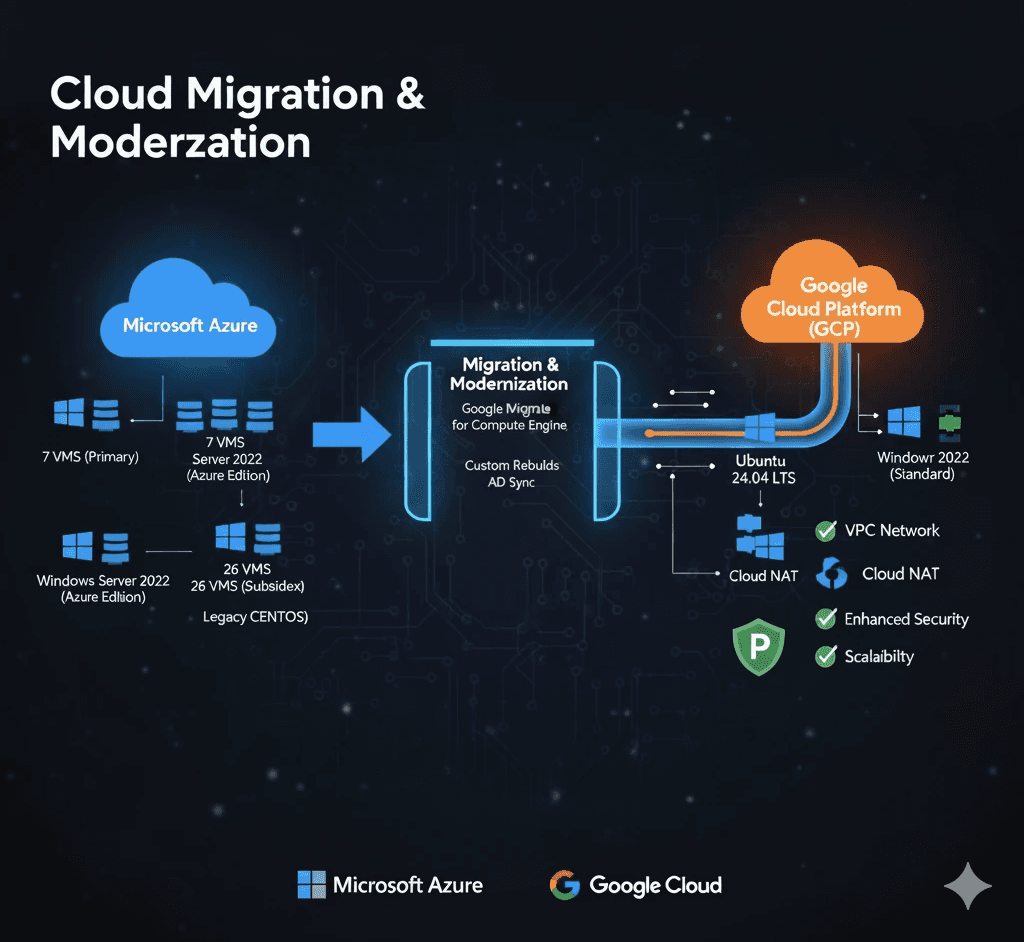
To overcome these limits and prepare for future growth, DextraLabs chose to migrate 33 Virtual Machines to Google Cloud Platform (GCP), targeting superior scalability, security, and cost efficiency.
2. Migration Objectives & Scope
Objective | Scope of Work |
|---|---|
Secure Foundation | Build a secure and scalable GCP landing zone (VPC networks, IAM, governance). |
Workload Transition | Migrate 33 VMs (Linux & Windows) across two Azure subscriptions. |
Modernization | Modernize outdated OS versions (e.g., CentOS) and improve overall compatibility. |
Operational Continuity | Preserve critical IP mappings, DNS settings, and Active Directory authentication. |
3. The Specialist Solution: Hybrid Recovery & AD Transition
The migration was not straightforward, particularly due to compatibility issues with critical systems, requiring a specialized, hybrid approach:
Challenge | GCP Service/Resolution |
|---|---|
Unsupported Windows Image → Resolution (Hybrid Recovery): Rebuilt the VM using Windows Server 2022 Standard on Azure, migrated AD, and then successfully moved the supported VM to GCP. | Azure's proprietary Windows Server 2022 (Azure Edition) was incompatible with GCP. |
Legacy CentOS Systems → Resolution (Modernization): Replaced them with new, secure Ubuntu 24.04 LTS VMs, then used a disk-based migration and | Older CentOS VMs were unsupported in the GCP marketplace. |
IP Conflicts & NAT → Resolution: Reserved identical internal IPs in GCP, and implemented Cloud NAT for verified outbound connectivity. | Internal IP reuse and NAT Gateway configuration mismatches caused network failures. |
Authentication Failures → Resolution: Verified DNS forwarders, AD replication, and conducted intensive login testing across both environments. | Domain issues post-AD migration and synchronization. |
Key Tools Used: Google Migrate for Compute Engine (M4CE), Cloud NAT, GCP Compute Engine, Ubuntu 24.04, Active Directory.
4. Results: A Foundation for Growth
The Azure-to-GCP migration was completed with zero data loss and minimal downtime, establishing a robust foundation for Dextra Labs’ future.
Cost Reduction: ~30% decrease in infrastructure expenses via GCP's sustained-use discounts.
Performance Uplift: Reduced network latency and improved application response times.
Enhanced Security: Centralized IAM policies and standardized, secure OS builds (Ubuntu 24.04).
Future-Proofing: Laid the groundwork for next-generation modernization like containerization and CI/CD.
Part II: Critical Database Modernization
5. The Challenge: End-of-Support and Zero-Downtime
Following the infrastructure migration, a crucial database modernization was required.
DextraLabs' primary PostgreSQL database, hosted on GCP Cloud SQL, was running version 11, which had reached end-of-support (EoS). This resulted in higher maintenance costs and security risks.
Constraint | Detail |
|---|---|
EoS Compliance | Must upgrade from PostgreSQL v11 to v16 to maintain support and security. |
Data Size | Massive 900 GB database made traditional backup-and-restore methods too slow. |
Downtime Constraint | The application is business-critical; downtime exceeding one hour was unacceptable. |
6. The Solution: GCP Database Migration Service (DMS)
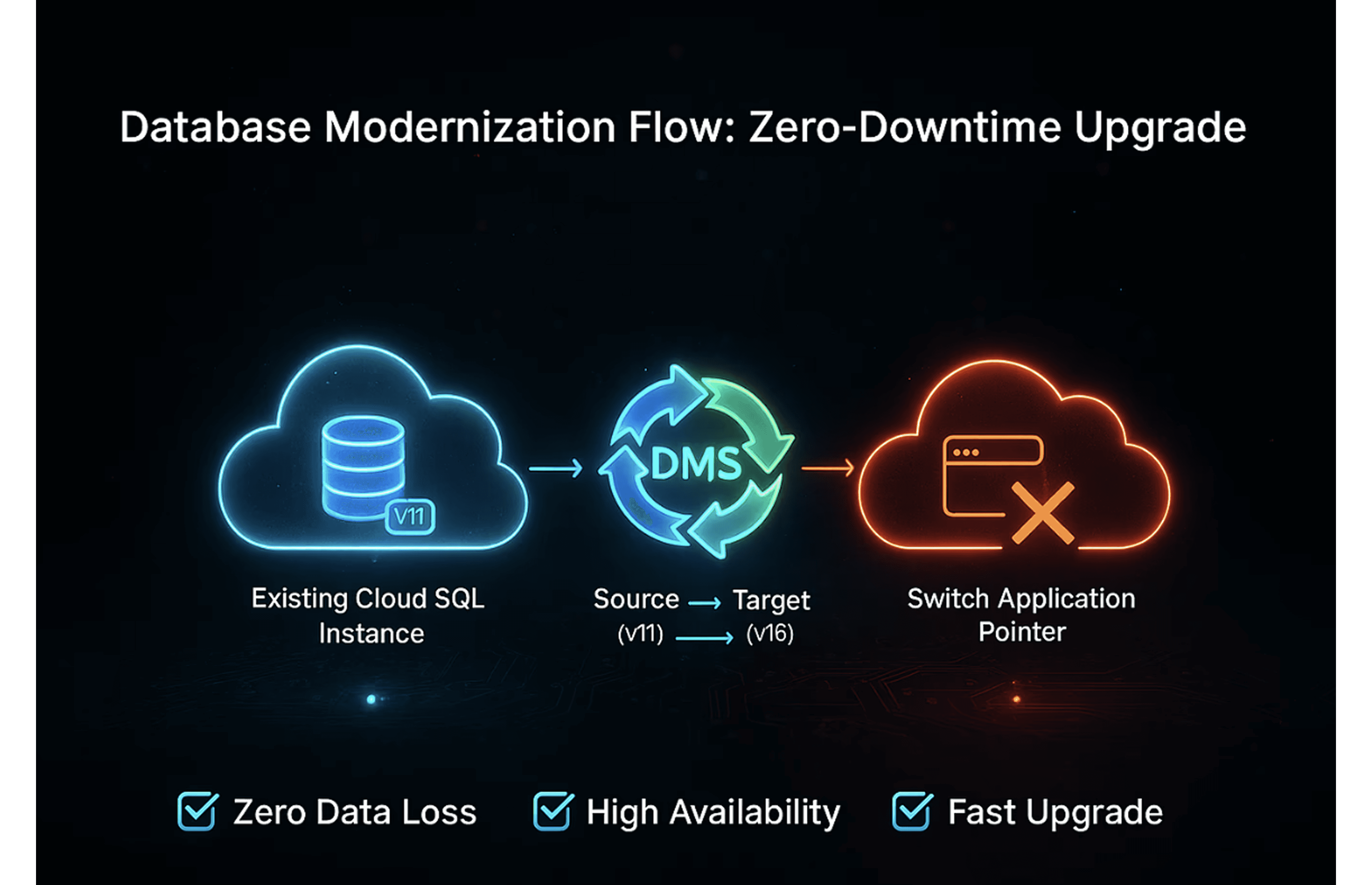
To ensure minimal service interruption, the team leveraged GCP’s native Database Migration Service (DMS) for a live, streaming upgrade:
A new Cloud SQL instance (PostgreSQL v16) was set up to be the target.
DMS was configured to perform continuous data replication from the live v11 source to the new v16 target.
Once the target was in sync, a final, fast cutover was executed: the old instance was stopped, and the application's configuration was immediately pointed to the new v16 instance.
7. Business Impact: Modernization in Minutes
The DMS approach delivered a rapid and reliable upgrade, transforming the operational timeline.
Total Downtime: Less than 30 minutes
(A 70% reduction compared to estimated downtime from traditional backup methods)
Zero Data Loss: Live replication guaranteed data consistency.
Compliance: Successfully transitioned to the fully supported PostgreSQL v16.
Performance: The customer benefited from the improved performance and security features of the latest database version.
Conclusion: Setting the Standard for Hybrid Migration
The DextraLabs engagement demonstrated the power of a comprehensive, hybrid migration strategy. By tackling complex cross-cloud OS incompatibilities, executing a sensitive AD transition, and performing a zero-downtime database upgrade, the project not only migrated the infrastructure but also accelerated the entire organization's modernization roadmap.
This successful project established a blueprint for secure, scalable, and cost-effective operations, positioning DextraLabs for exponential growth on Google Cloud.